Shift 'n' Ship started long before this version of it: on a sheet of paper, in 2004.
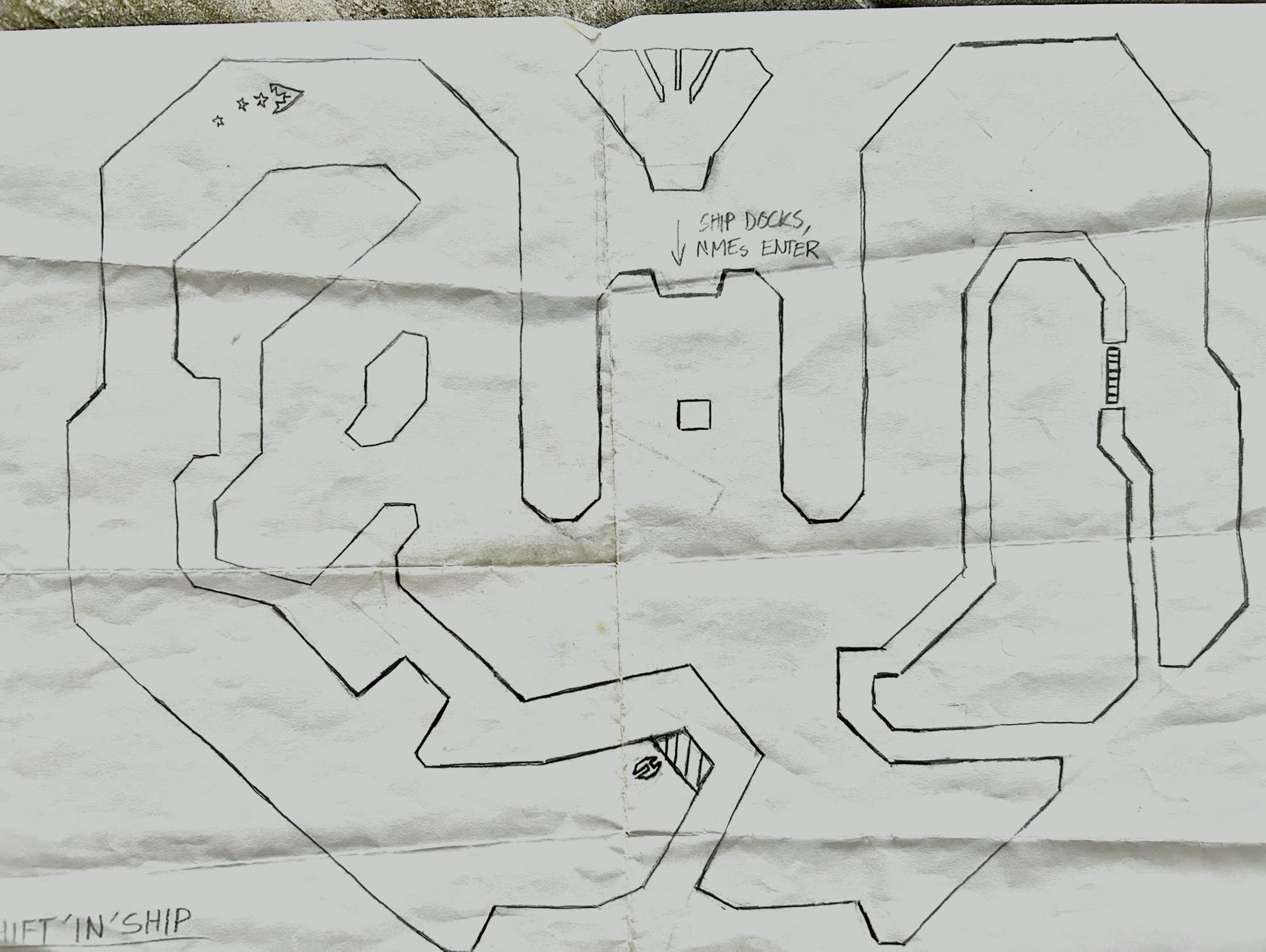
This pencil drawing was made for the original game, written in C++ on a basic custom 2D engine that drew polygons with simple texture fills. It shows a mothership's corridors seen from above, on a page that has been folded and creased in the years since. The title in the corner even spells the name differently: Shift 'in' Ship.
Most of what's on the page is still in the game:
- Top left: an interceptor, firing its flare-like rounds. It's still the first hostile you meet.
- The bay mouth: a capital ship docking, with the note "Ship docks, NMEs enter." Hostiles still come into a rig through its bay mouths.
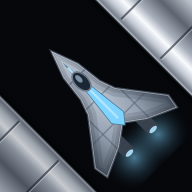
- The bottom: the scout, the ship you fly, sitting on a repair bay. That was the starting point.
In the original design, the whole game took place inside the mothership. There was no open space at all until a second sketch, months later, put the ship out among the stars. Today every mission is a stretch of open space with rigs, lodes and capital ships in it, and much of the fighting happens between them.
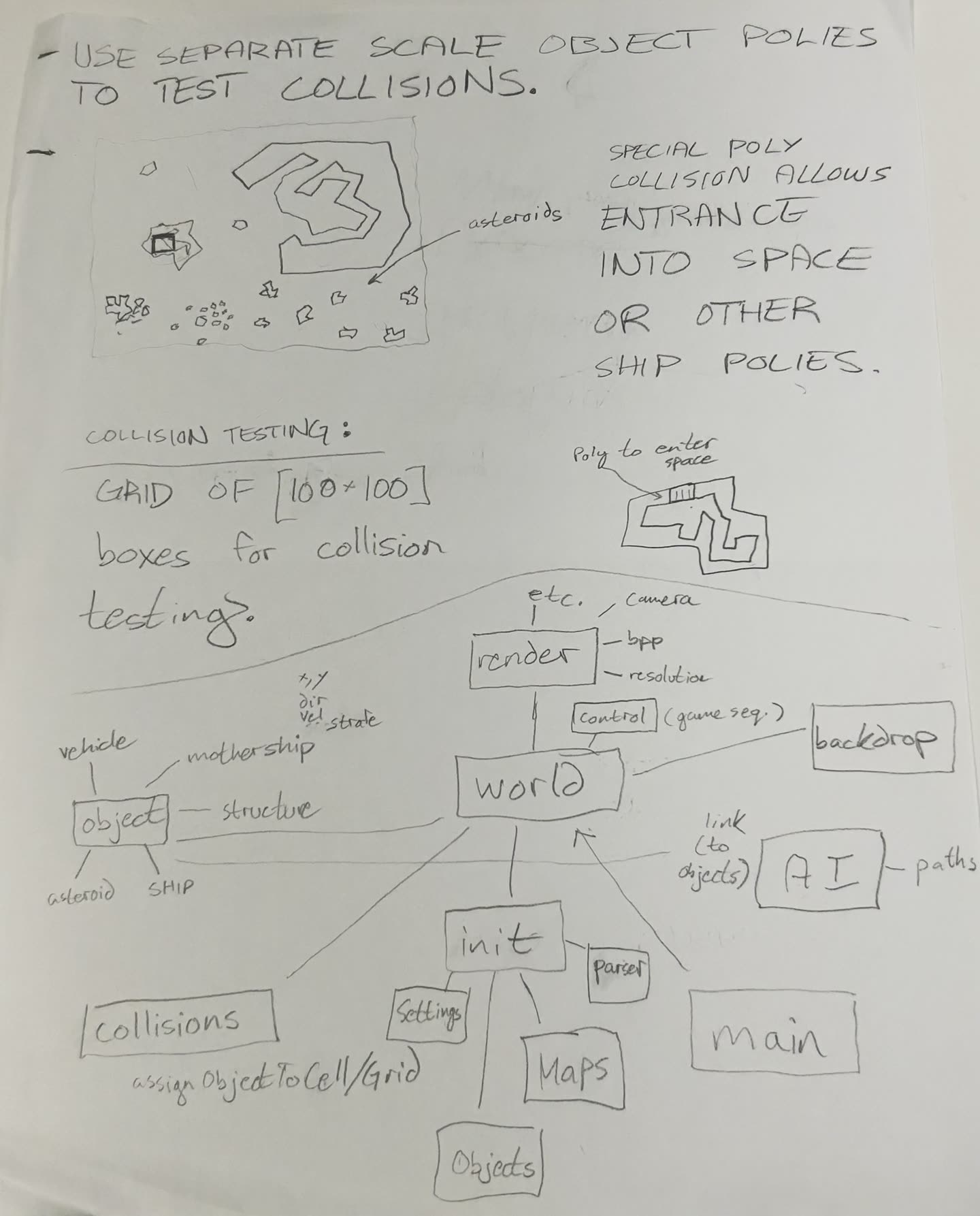
This is that second sketch. It's half picture and half plan for the code, and a lot of it is still how the game works:
- Open space: a mothership drawn on its own, with asteroids drifting around it. That's what every mission looks like now.
- A way in: "special poly collision allows entrance into space or other ship polies", with a striped opening marked on a hull. Today those are the bay mouths, and they still wear stripes.
- A grid for collisions: "grid of 100 x 100 boxes for collision testing". The game still lays every rig out on a grid of cells, for collisions and for the routes hostiles take through the corridors.
- The program: a diagram of the parts, with the world in the middle and render, objects, collisions, AI paths, the backdrop and the start-up code around it. Most of those parts are still there.
What a drawing can't show is motion. In the game, every mothership drifts and slowly turns for the whole mission, and your scout doesn't move with it, so the corridors swing toward you as you fly them. Reading the walls is half the fight.
I started the project up again in August 2026 and ported the early concept and game from C++ to a fully web-based HTML5 game. The first thing the new version did was generate a rig from the sketch's line work: stepped, angular walls and corridors that wind back on themselves.
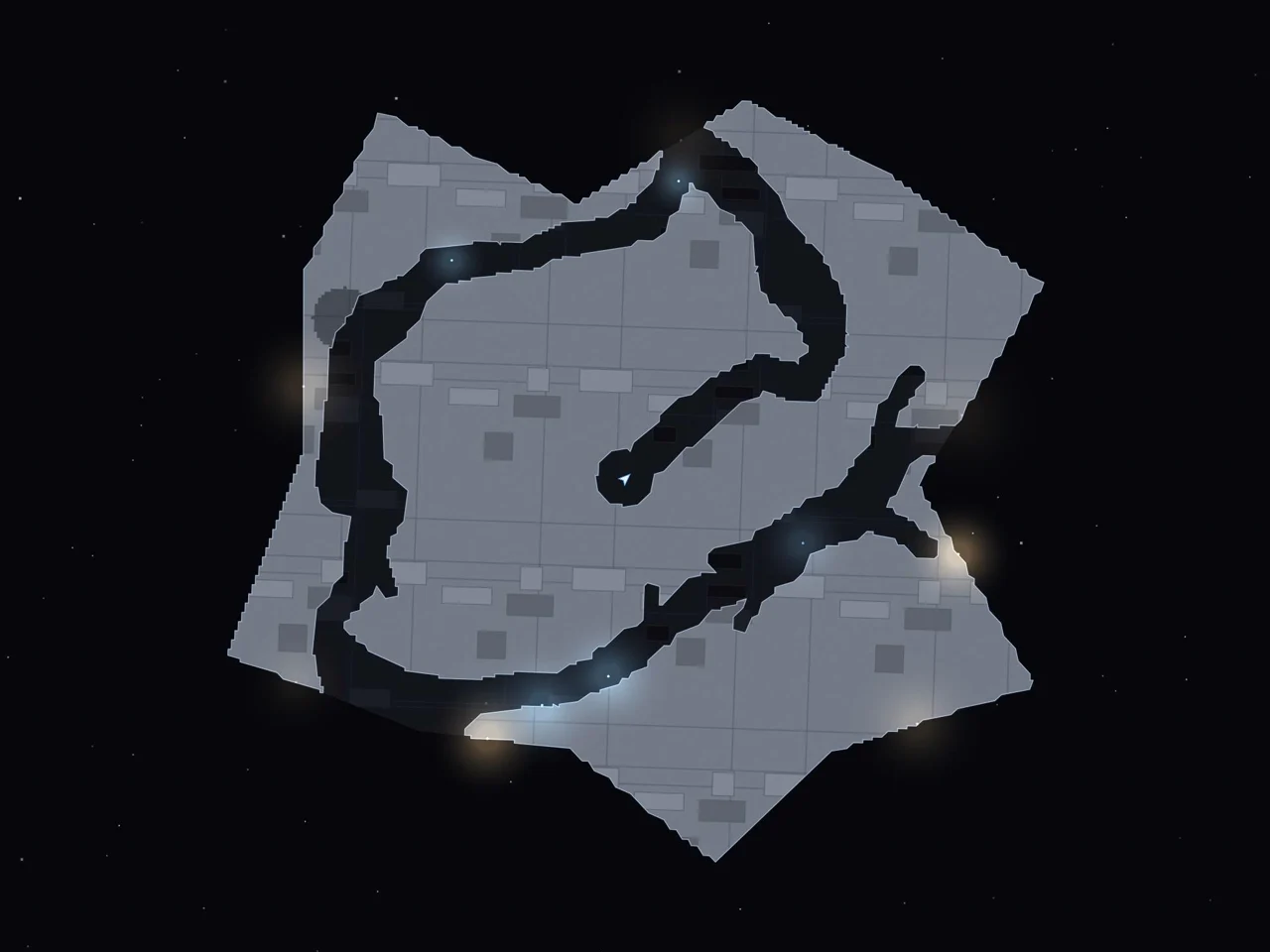
It has come a long way since, thanks to AI tools that sped up development of what is still a solo project. Today it has 60 missions and a weekly Challenge with a leaderboard, and it plays free in any modern browser.
Both sketches are in the press kit with the screenshots, if you'd like the full-size scans.